
The Problem: When the Knee Fails You
- Knee Locking (Joint Block): A mechanical obstruction where a torn piece of meniscus gets caught between joint surfaces, like a stone in a doorway. You feel a sudden inability to fully straighten or bend the leg, accompanied by acute pain.
- Meniscus Tear (Pain Under Load): Pain is typically localized along the joint line, worsening when going downstairs or during deep squats. Without treatment, the damaged meniscus acts like a “grater,” rapidly destroying healthy cartilage.
- Joint Instability (ACL Tear): A feeling that the leg “doesn’t hold you,” buckling or shifting during movement. This is the primary sign of an Anterior Cruciate Ligament (ACL) tear, causing uncertainty during sudden turns.
- Baker’s Cyst and Synovitis: Inflammatory fluid accumulation behind the knee, feeling like a tight lump. A cyst is not a standalone disease but a consequence of an internal joint issue (usually a meniscus tear). Removing it without treating the cause is ineffective—it will return.
Methodology: Minimally Invasive Precision
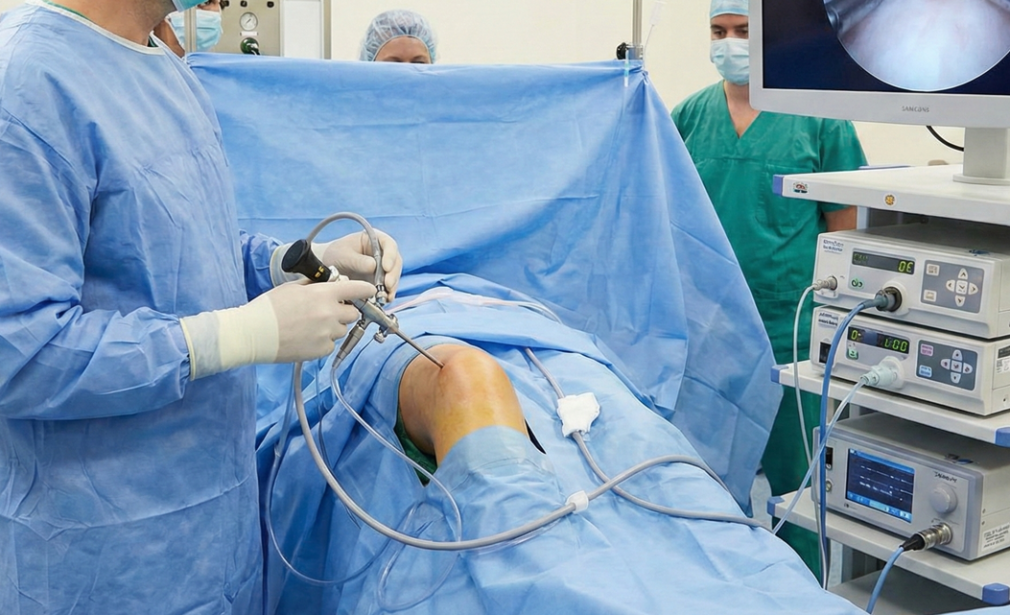
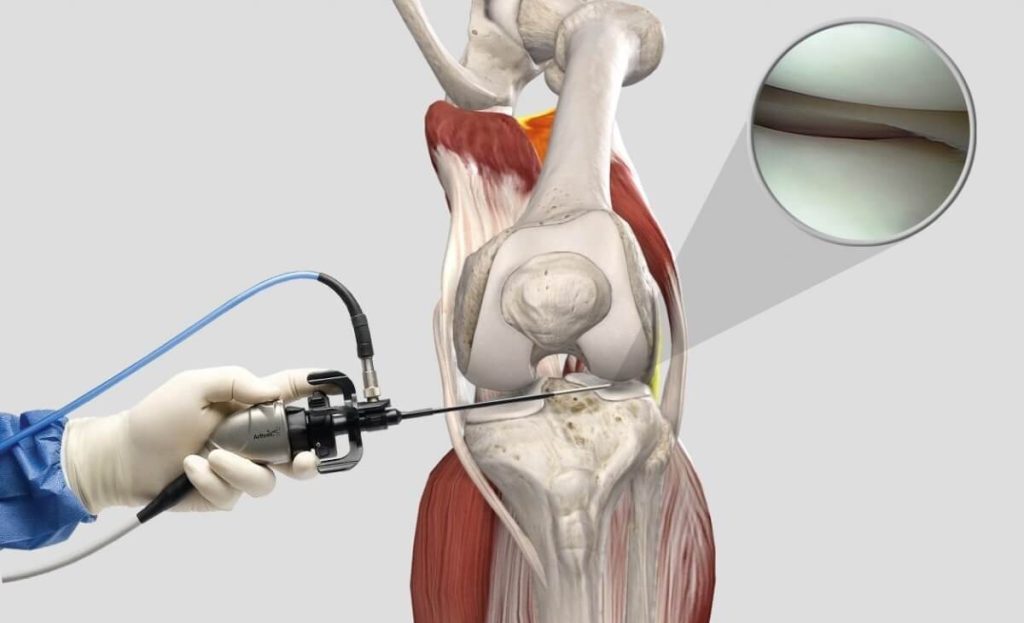
- Minimal Trauma: We use two miniature 4–5 mm portals for the camera and instruments. This ensures no gross scarring, minimal swelling, and rapid skin healing.
- High-Precision Optics: The arthroscope provides 20x magnification, allowing the surgeon to see damage often missed by MRI and perform surgical work with jeweler-like precision.
“In modern orthopedics, we avoid total meniscus removal as it leads directly to arthrosis. My philosophy: if there is even the slightest chance to suture the meniscus, I will do it to preserve your knee’s ‘shock absorber’ for years to come.”
Preparation for Surgery
- Medical Screening (Preoperative Package): 1–2 days before the intervention, you need to complete a standard package of tests (blood, urine, coagulation profile) and an ECG. This is necessary for the anesthesiologist to rule out hidden heart or blood clotting issues and to select the safest form of pain relief.
- Dietary Guidelines: The surgery is performed on an empty stomach. Your last meal should be a light dinner the evening before. On the morning of the surgery, you are strictly prohibited from eating or drinking water. This is a standard safety requirement for any anesthesia.
- Hygiene and Clothing: Take a shower on the morning of your visit and shave the knee area (or we can do it on-site with a trimmer). Please bring comfortable, loose-fitting clothing (shorts or spacious sweatpants) that can easily fit over a bandaged leg, as well as crutches (for support on the first day).
The Surgical Process
- Arthroscopic Stage: Through 5 mm punctures, the camera and micro-instruments are inserted. The surgeon views the joint on a 4K monitor and meticulously “repairs” the meniscus or reconstructs the ligament.
- Anesthesia and Comfort: In the operating room, the anesthesiologist performs an injection in the lower back (spinal anesthesia). Within 5–10 minutes, you will lose sensation in your legs while remaining fully conscious. You can listen to music through headphones or communicate with the doctor throughout the procedure.
- Completion: After checking stability, the fluid is washed out, and instruments are removed. We apply 1–2 cosmetic sutures and a sterile dressing. No cast is used—only elastic bandaging.
Rehabilitation
- Early Mobilization: From the first days, you visit the clinic for dressings and initial exercises. I personally monitor the flexion angle and technique.
- Physiotherapy: We use specialized equipment to reduce swelling and stimulate muscles, accelerating your return to walking without a limp.
- Return to Sports Control: I provide clearance for training only after functional tests prove the ligament is stable and muscle tone is fully restored.
Часто задаваемые вопросы
- No, in 95% of cases, we use spinal anesthesia. You remain conscious but feel absolutely no pain in your legs. It is safer for the heart.
Practically none. The 4–5 mm punctures look like tiny scratches or moles over time.
3–4 weeks after meniscus “cleaning”; 6–8 months after ACL reconstruction.
Yes, 1–2 cosmetic sutures are removed on days 10–12. It is quick and painless.
Suturing is always better to prevent arthrosis, but it is only possible with fresh injuries.